
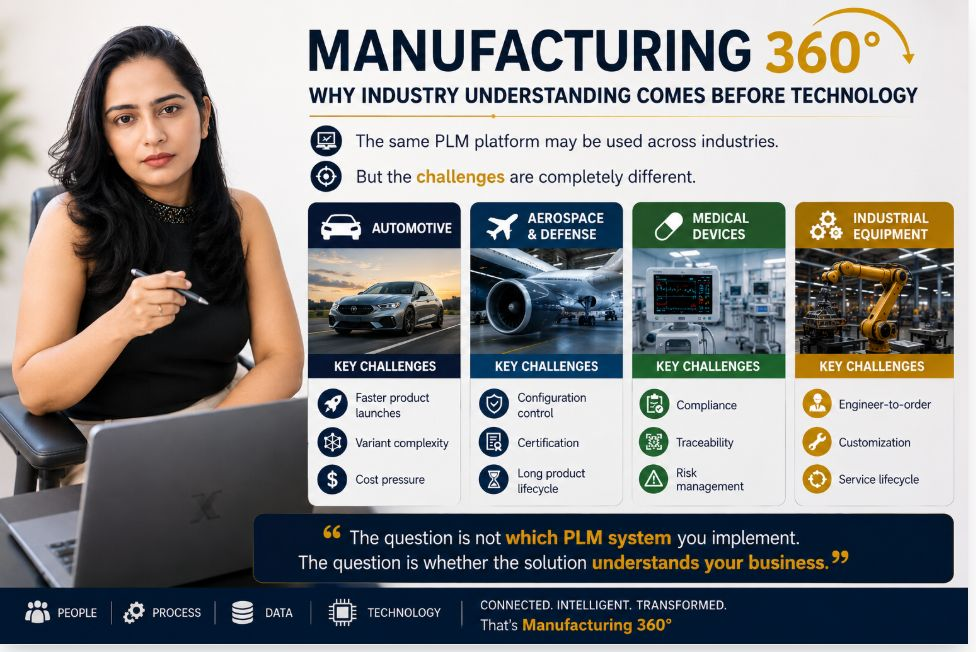
A Product Lifecycle Management (PLM) platform can support organizations across a wide range of industries.
Whether it’s Automotive, Aerospace & Defense, Medical Devices, Industrial Equipment, or High-Tech Manufacturing, the technology itself is designed to manage product data, streamline processes, and enable collaboration throughout the product lifecycle.
However, technology alone is not what drives successful digital transformation.
Every Industry Has Its Own Challenges
While the platform may be the same, every industry operates within a unique business environment.
Each has its own:
- Regulatory and compliance requirements
- Product development processes
- Engineering workflows
- Supply chain complexities
- Quality standards
- Business priorities
An approach that works for an automotive manufacturer may not align with the needs of a medical device company. Likewise, aerospace organizations face challenges that differ significantly from industrial equipment manufacturers.
Understanding these differences is essential before implementing any technology.
Technology Should Adapt to the Business
One of the most common misconceptions is that implementing a PLM solution automatically solves business challenges.
In reality, technology is only an enabler.
The real value comes from configuring the solution around an organization’s products, processes, and people—not forcing the business to adapt to the software.
A successful implementation begins with asking the right business questions before discussing features and functionality.
Industry Knowledge Drives Better Outcomes
Organizations achieve better results when technology partners understand how their industry operates.
That means understanding:
- How products are designed and engineered
- How teams collaborate across departments
- How compliance and quality requirements are managed
- How change is controlled throughout the product lifecycle
- Where operational bottlenecks impact productivity
This industry-first approach helps ensure that technology supports business objectives rather than becoming another disconnected system.
The Right Question to Ask
When evaluating a PLM solution, the first question shouldn’t be:
“Which PLM system should we implement?”
Instead, ask:
“Does this solution—and the team implementing it—understand our business, our industry, and the way we work?”
Because successful digital transformation doesn’t start with technology.
It starts with understanding the industry, the business, and the people behind it.