
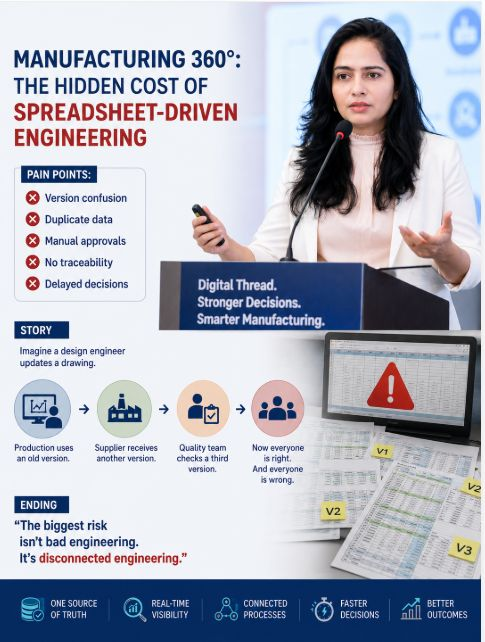
Digital transformation has become one of the most discussed topics in manufacturing.
What receives far less attention is the cost of not transforming.
Disconnected systems, fragmented product data, and manual information sharing often create hidden operational risks that extend well beyond the engineering department.
Disconnected Information Has Real Business Consequences
Sometimes, the problem starts with something as simple as an outdated spreadsheet.
A single inaccurate version of product data can lead to:
- Delayed production schedules
- Costly engineering rework
- Supplier misalignment
- Manufacturing errors
- Quality issues and compliance risks
These are rarely isolated incidents. They often reflect a broader challenge—engineering information that is scattered across multiple systems instead of being managed as a connected digital asset.
The Challenge Isn’t Engineering Talent
Manufacturing organizations have some of the most capable engineering teams in the world.
The issue isn’t a lack of expertise.
The issue is that many teams are still expected to make critical decisions using disconnected tools, duplicate data, and inconsistent sources of information.
When engineering, manufacturing, quality, procurement, and service operate from different versions of the truth, collaboration slows and business risk increases.
Winning Organizations Build on Connected Data
The manufacturers leading digital transformation aren’t succeeding simply because they employ better engineers.
They succeed because every team works from a trusted, connected source of product information throughout the product lifecycle.
This enables:
- Faster and more informed decision-making
- Improved cross-functional collaboration
- Greater product quality and traceability
- Reduced rework and operational waste
- Faster response to engineering changes
Digital continuity transforms product data from isolated information into a strategic business asset.
Engineering Excellence Requires Digital Continuity
Engineering excellence is essential—but on its own, it is no longer enough.
Without connected systems and reliable product data, even the strongest engineering teams face unnecessary complexity and operational risk.
Organizations that invest in digital continuity don’t just improve engineering efficiency.
They strengthen the entire manufacturing value chain—from concept and design to production, service, and continuous improvement.
Because in modern manufacturing, competitive advantage isn’t built on disconnected information. It’s built on connected intelligence.