
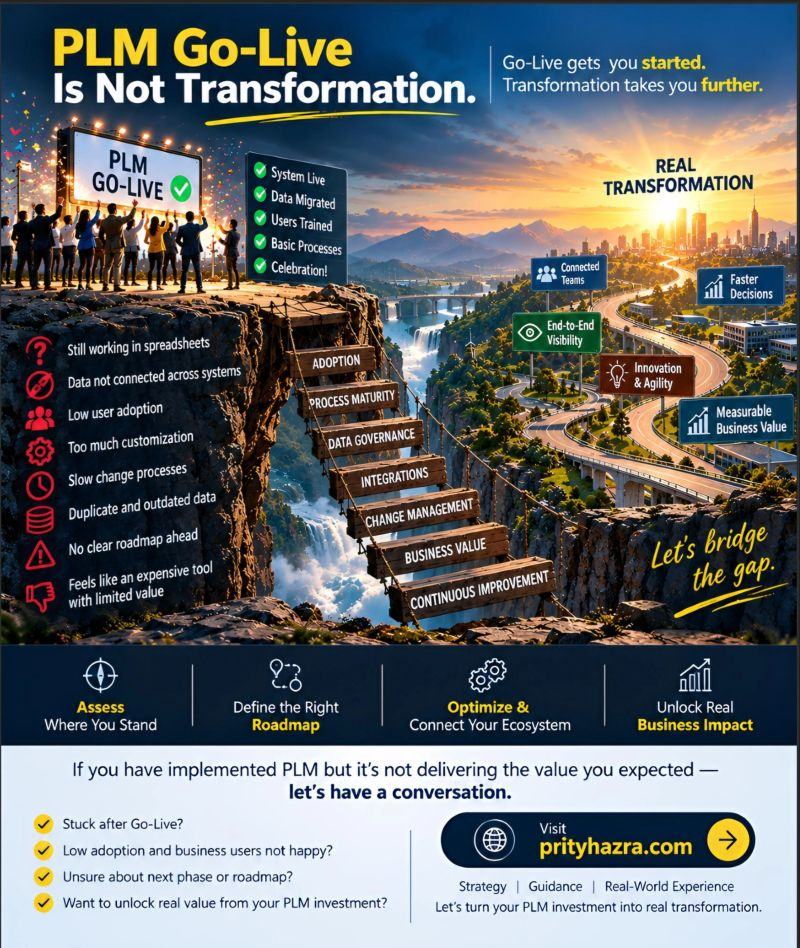
PLM Go-Live is not the finish line—it’s the starting point.
For any organization investing in Product Lifecycle Management (PLM), going live is a significant achievement. It represents months of planning, configuration, data migration, integrations, testing, and collaboration.
But once the system goes live, an important question emerges:
Have we truly transformed the way we manage our product lifecycle, or have we simply implemented another enterprise system?
A successful PLM implementation is not defined only by delivering the agreed scope or making the system available to users. Its real success lies in how effectively the organization adopts the platform, improves its processes, connects its data, and realizes business value.
Go-live is a milestone. Transformation is an ongoing journey.
1. User Adoption: Beyond Training and System Access
One of the biggest challenges after implementation is getting people to embrace the new way of working.
Training users and providing system access do not automatically translate into adoption.
Engineers may continue using local folders, spreadsheets, and emails. Teams may maintain parallel processes because they are more familiar with existing practices.
Real adoption happens when users see PLM as an enabler of their everyday work rather than an additional administrative responsibility.
This requires continuous engagement, practical support, and an understanding of the challenges users face.
Adoption is not about how many people have been trained. It is about how effectively people use the system to work differently and better.
2. Process Evolution and Connected Engineering
Implementing PLM often involves translating existing business processes into digital workflows. But simply digitizing existing processes does not guarantee improvement.
Organizations should continuously evaluate how engineering changes are managed, how product structures are maintained, and how engineering and manufacturing teams collaborate.
The post-go-live phase provides an opportunity to simplify workflows, strengthen governance, and eliminate inefficiencies.
Equally important is connecting engineering information across the product lifecycle.
PLM should not operate as an isolated repository. Its value increases when connected with CAD, ERP, MES, ALM, and other enterprise applications.
This is where the Digital Thread becomes important — connecting requirements, designs, product structures, validation, manufacturing, and service information.
The objective is simple: ensure the right information reaches the right people at the right time.
3. Measuring Business Value
A PLM implementation can successfully deliver every technical milestone and still leave one important question unanswered:
What measurable value has the organization realized from its investment?
The focus should move beyond users onboarded, documents migrated, and workflows configured.
Organizations should evaluate improvements in:
- Engineering productivity and reduced information search time.
- Faster engineering change and release cycles.
- Improved data accuracy and traceability.
- Reduced duplication and manual coordination.
- Better engineering and manufacturing collaboration.
The objective is to move from measuring system performance to measuring business performance.
4. The Next Roadmap: PLM Is a Continuous Journey
Business requirements evolve, products become more complex, and engineering organizations continue to grow.
A PLM roadmap should evolve accordingly.
Once the initial implementation stabilizes, organizations should explore opportunities to strengthen adoption, improve process maturity, expand functional capabilities, and connect enterprise systems.
This may include advanced BOM management, configuration management, quality integration, model-based engineering, analytics, digital thread, and AI-enabled engineering.
However, the roadmap should be driven by business priorities, not simply by available technology.
The most successful PLM environments are those that continuously evolve with the needs of the business.
My Perspective: From Implementation to Transformation
I believe we need to change the way we define PLM success.
Too often, the conversation focuses on implementation timelines, technical deliverables, and project closure. These are important, but they represent only one part of the journey.
The real transformation happens when people adopt the system, processes become more effective, engineering information becomes connected, and businesses begin to see tangible value.
For me, meaningful digital transformation comes down to four interconnected dimensions:
Technology → Process → People → Outcomes
Technology provides the foundation. Processes establish how work gets done. People make the transformation sustainable. Outcomes demonstrate whether the effort is delivering value.
None of these dimensions can work in isolation.
Is Your PLM Journey Delivering the Value You Expected?
If your PLM system is already live but user adoption, process maturity, business value, or the next roadmap remains unclear, there is an opportunity to bridge that gap.
The conversation should move beyond what has been implemented and focus on what the organization can achieve next.
Move beyond implementation. Make technology work for the business.
Let’s connect and explore how organizations can get more value from their PLM investments.